
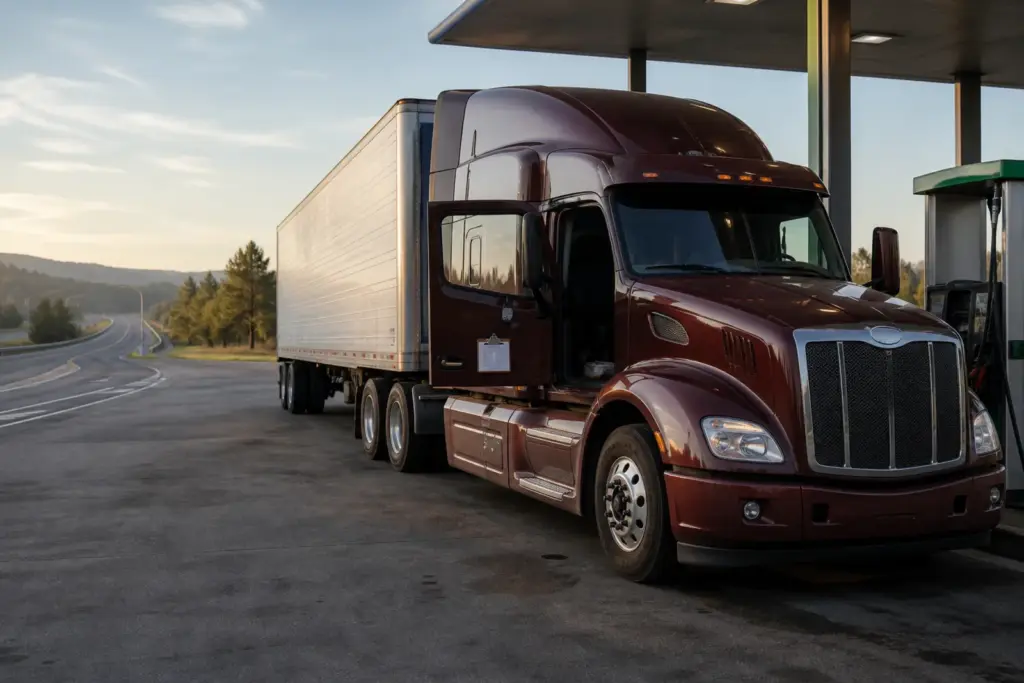
Trucking permit services identify and obtain the state or route-specific credentials a carrier needs beyond its federal authority, registration and ordinary operating documents. The work may include trip permits, temporary fuel permits, oversize or overweight permits, state highway-use accounts and commodity-specific credentials. There is no single “all states” permit that makes every movement legal.
Which trucking permits might apply?
| Permit or credential | Typical use | Not a substitute for |
|---|---|---|
| Temporary trip permit | Short-term operation when the vehicle lacks apportioned registration authority for a jurisdiction | Federal operating authority, insurance or other state permits |
| Temporary fuel permit | Jurisdiction travel when the operation is not covered by an IFTA license and decals | Trip registration or highway-use tax accounts |
| Oversize or overweight permit | Movement exceeding a jurisdiction’s ordinary legal dimension or weight limits | Route compliance, escorts, curfews or local permits |
| Highway-use or weight-distance account | State tax or registration obligation tied to miles, weight or operation | IFTA, IRP or Form 2290 |
| Commodity or location permit | Movement regulated because of cargo, facility, port or local conditions | Hazmat registration, safety permits or required endorsements |
What a permit provider should verify before ordering
A provider should not issue from a guessed equipment profile. It needs the carrier’s exact legal name, USDOT and authority details, insurance status, plate and registration, unit VIN, power-unit and trailer configuration, axle count and spacing, registered weight, commodity, route and movement dates. For dimension or weight permits, actual measurements and axle weights matter.
The provider should also ask whether the vehicle operates under IRP and IFTA, whether the movement is interstate or intrastate, and whether local jurisdictions or toll facilities impose separate rules. A state permit may authorize state highways but not city streets, county roads or a restricted bridge.
A professional permit workflow
- Screen the movement. Identify jurisdictions, vehicle status, cargo and possible permit categories.
- Validate credentials. Check that authority, insurance, registration and tax accounts support the requested trip.
- Confirm route data. Use accurate origin, destination, dimensions, weights and travel dates.
- Submit to the proper authority. Follow each jurisdiction’s portal, documentation and payment rules.
- Review issued conditions. Check dates, unit identifiers, route, restrictions, escorts and required documents before dispatch.
- Carry and retain proof. Put the correct permit in the vehicle and store a copy with trip and payment records.
Same-day service has limits
Some routine temporary permits can be issued quickly. Complex oversize movements, nondivisible-load questions, route studies, bridge reviews, weekend restrictions or local approvals may take longer. A reputable provider will identify the true lead time instead of promising instant approval for every state and load.
Dispatch should not assume an application receipt authorizes movement. The carrier needs the issued permit and must check it for errors. A wrong plate, VIN, route, date or dimension can invalidate the authorization even if a fee was paid.
How to compare trucking permit services
- Which states and local jurisdictions do you support directly?
- Do you identify what is required, or only order the permit name we request?
- How do you verify legal name, authority, insurance and vehicle data before submission?
- Will you provide government fees and service charges separately before approval?
- Who reviews route restrictions, curfews, escort needs and weather limitations?
- How are amended or cancelled trips handled?
- Can dispatch receive issued permits and conditions in a mobile-friendly package?
- Do you maintain a credential calendar for recurring state accounts and renewals?
- What happens when an agency portal is unavailable or approval requires manual review?
Common permit failures
Frequent problems include ordering a fuel permit but not a trip permit, moving on an expired date, using a permit for a different vehicle or load, missing a local permit, deviating from the approved route, and failing to carry the document. Carriers also lose time when the permit request uses rounded dimensions or an assumed axle spacing that the issued document cannot support.
Prepare a reusable vehicle profile
Maintain verified profiles for each power unit and trailer with VIN, plate, registered weight, dimensions, axle data, insurance and credential copies. Still confirm the actual configuration and load before each request. A reusable profile reduces typing errors; it should never freeze old information into a new permit.
For permanent registration and fuel credentials, see IFTA and IRP setup. Loads exceeding ordinary legal dimensions or weights should use oversize and overweight permit services.
How DCC helps with this service
DOT Compliance Companies is a provider-matching marketplace. We help carriers and drivers compare listed providers and send a request to suitable businesses. The selected provider confirms its own scope, credentials, coverage and deliverables. Regulated decisions and the motor carrier's legal duties remain with the responsible parties described on this page.
Identify permits for your trip
Share the carrier, vehicle, route, cargo, travel dates and current IRP or IFTA credentials.
Request trucking permit support