
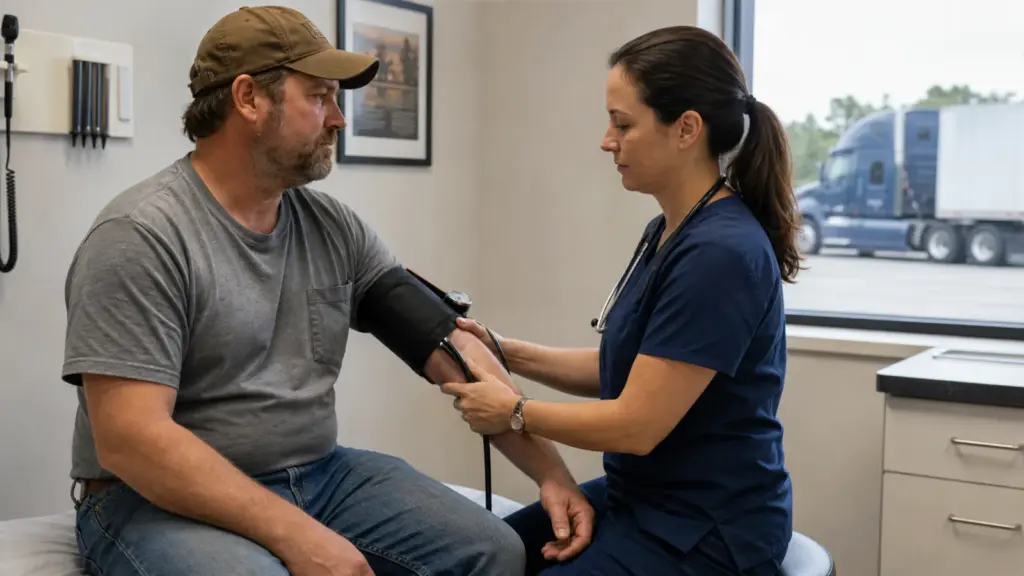
DOT physical exams determine whether a commercial driver meets the federal physical qualification standards for safety-sensitive driving. The examination must be completed by a medical examiner listed on the FMCSA National Registry of Certified Medical Examiners. A useful scheduling or compliance provider does more than offer an appointment slot. It explains what to bring, verifies the appointment details, coordinates requested documents and gives the carrier a clear status. The certified medical examiner remains responsible for the examination, qualification decision and required medical-exam reporting.
Who should arrange a DOT physical?
Interstate commercial motor vehicle drivers who are subject to the physical qualification rules in 49 CFR 391.41 generally need medical certification. State rules also affect intrastate drivers, CDL self-certification and how medical status is recorded. The carrier should confirm coverage instead of assuming that every employee with a driver’s license needs the same examination.
New CDL drivers
A driver may need a current medical certification before operating in a non-excepted category. The training school, employer and State Driver Licensing Agency can have separate administrative steps.
Renewing drivers
Book early enough to resolve missing records, specialist information or a shorter certification period without allowing the current medical status to lapse.
Drivers returning after illness
When a physical or mental injury or disease has impaired the driver’s ability to perform normal duties, 49 CFR 391.45 requires re-examination and certification before qualifying CMV operation resumes, even if the existing certificate has not reached its printed expiration date.
Owner-operators
The owner-operator or authorized motor carrier retains responsibility for examination status and carrier records. Scheduling and administration can be delegated, but compliance responsibility cannot.
What a DOT physical exam service should help you prepare
The medical examiner makes an independent qualification decision. A clinic or scheduling provider should never promise that a driver will pass. It should help the driver arrive with complete, accurate information so the examiner can make the decision on the evidence available.
| Before the examination | Why it matters | What may follow |
|---|---|---|
| Photo identification and driver information | The examiner must identify the person examined and complete the required FMCSA forms accurately. | The examination result and certification status are recorded against the correct driver. |
| Medication list and prescribing details | The examiner considers the medication, the condition being treated and possible effects on safe driving. | The examiner may request additional information from a treating clinician. The optional MCSA-5895 form can assist in some cases. |
| Relevant specialist records | Vision, hearing, cardiovascular, neurological, diabetes and other conditions can require supporting evidence or a specific federal form. | Certification, a shorter certification period, a pending determination or a finding that the driver is not medically qualified. |
| Glasses, contacts or hearing aids | Corrective devices used for driving should be available during the examination. | A restriction may appear on the medical certificate when the driver is qualified only while using the device. |
| Sleep treatment information when applicable | The examiner may need evidence that a diagnosed condition is being treated effectively. | Additional records or a shorter certification period may be requested for monitoring. |
Drivers should answer the Medical Examination Report Form truthfully. A clinic should not coach a driver to omit a diagnosis, medication or previous medical event. If a record is unavailable, ask the examiner what evidence is required and how the determination will be handled.
What happens during the appointment?
The certified medical examiner reviews the driver’s health history and completes the examination required by 49 CFR 391.43. The process includes measurements and assessments relevant to the federal qualification standards, including vision, hearing, blood pressure, urinalysis and a physical examination. The urinalysis used in the DOT physical is part of the medical examination. It is not the controlled-substances test required by Part 382.
A medical examiner’s certificate may be valid for up to 24 months. The examiner can certify for a shorter period when closer monitoring is appropriate. A shorter card is not automatically an error, and a provider should not promise to replace it with a longer one.
After the exam: certificate, state record and DQ file
Passing the examination is not the final administrative step for every driver. CDL holders must keep their State Driver Licensing Agency self-certification and medical status current under the process used by their state. Electronic reporting through the National Registry has changed how results reach state systems, but drivers and carriers should still confirm the current state procedure and retain the documentation their operation needs.
For CLP and CDL drivers in the integrated process, the carrier generally verifies current medical status through the motor vehicle record obtained from the driver’s current licensing state and keeps the evidence required by the current qualification-file rule. Non-CDL drivers subject to Part 391 follow a different certification-record route. The detailed Medical Examination Report is a medical record and should not routinely be placed in the ordinary driver qualification file. In every case, the carrier remains responsible for preventing operation when medical qualification or the applicable license status is not current.
How to compare DOT physical exam providers
- Verify National Registry status. Search the examiner, not only the clinic brand. Confirm that the individual who will conduct the examination is actively listed.
- Ask what records to bring. A good clinic gives condition-specific preparation instructions without promising an outcome.
- Check commercial-driver experience. The staff should understand FMCSA forms, state medical-certification steps and the difference between a DOT physical and employer occupational-health services.
- Clarify pending cases. Ask how the clinic handles requested specialist records, incomplete examinations and corrections to clerical errors.
- Confirm accessibility. Drivers may need suitable appointment times, parking for larger vehicles, language assistance or an accessible examination setting.
- Protect medical information. The clinic should explain what is shared with the driver, carrier, FMCSA and state agency, and what remains confidential medical information.
For fleets arranging multiple examinations
Ask for a renewal roster, appointment confirmation process and a clear way to reconcile completed, pending and missed visits. Keep the clinic’s scheduling service separate from the carrier’s decision about whether a driver may perform safety-sensitive work.
When a result needs follow-up
A driver may need supporting records, an FMCSA exemption or a Skill Performance Evaluation certificate before being qualified. The medical examiner can identify the qualification issue and supporting medical information, while FMCSA decides federal exemption and SPE applications. A service provider can coordinate appointments and documents, but it cannot overrule the examiner, grant a federal approval or guarantee an outcome.
How DCC helps
DCC connects carriers and drivers with listed exam, scheduling and compliance providers. The selected provider confirms its own scope, coordinates the agreed work and returns the stated appointment or status records. The driver supplies accurate medical information, the examiner makes the medical qualification decision, and the carrier verifies the resulting status, maintains required evidence and controls whether the driver is dispatched.
Drivers who want to understand the visit itself can use our DOT physical requirements and medical card calculator. Carriers looking for ongoing record support should also review driver qualification file services.
How DCC helps with this service
DOT Compliance Companies is a provider-matching marketplace. We help carriers and drivers compare listed providers and send a request to suitable businesses. The selected provider confirms its own scope, credentials, coverage and deliverables. Regulated decisions and the motor carrier's legal duties remain with the responsible parties described on this page.
Arrange DOT physical exam support
Tell us where your drivers are located, how many appointments you need and your certification deadlines.
Request DOT physical support