
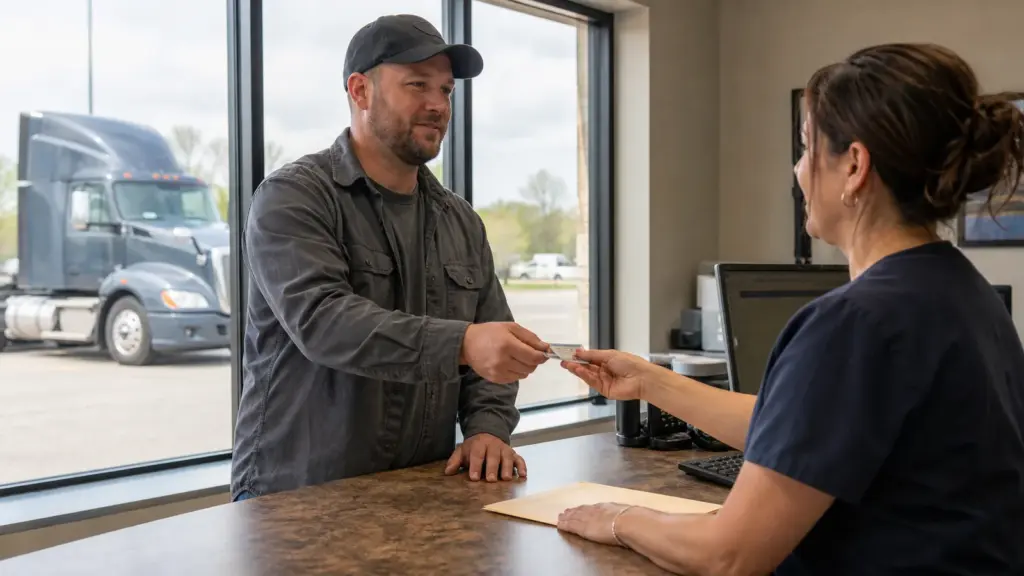
DOT pre-employment drug testing services help motor carriers arrange the required controlled-substances test before a covered driver first performs safety-sensitive functions for the employer. The practical risk is timing. A scheduled collection is not enough. The employer must have the verified negative result from the MRO or C/TPA before the driver is used in covered work, unless a narrow regulatory exception applies.
When is a DOT pre-employment test required?
For FMCSA-regulated employers covered by 49 CFR Part 382, a driver must generally complete a pre-employment controlled-substances test before performing safety-sensitive functions for the first time for that employer. The rule is drug testing, not a routine pre-employment alcohol test requirement. A carrier can have other hiring screens, but those should not be confused with the DOT test record.
Common triggers include hiring a new CDL driver, moving an employee into covered driving work, returning a driver after a break in testing-program coverage, or taking on an owner-operator arrangement where the motor carrier is responsible for the testing program. Owner-operators who employ themselves as drivers still have Part 382 responsibilities and normally need a C/TPA relationship for random testing program administration.
| Step | What must be controlled | Common carrier mistake |
|---|---|---|
| Driver intake | Legal name, CDL or CLP details, employer account, collection location and correct DOT authority. | Sending the driver to a non-DOT screen or using inconsistent driver identifiers. |
| Collection | Correct federal custody and control form process and Part 40 collection standards. | Treating a collection receipt as clearance to drive. |
| MRO result | Verified negative result received by the employer or its C/TPA before covered work. | Dispatching after the specimen is collected but before the verified result returns. |
| Record filing | Testing record, employer notes, evidence that the required Clearinghouse query was completed and any prior-program documentation. | Keeping scattered emails with no audit-ready testing file. |
From intake to verified result
A useful provider reduces confusion between the motor carrier, collection site, laboratory, MRO, C/TPA and driver. The carrier is still responsible for compliance, but the service agent can make the workflow more reliable when each handoff is documented.
- Set up the employer account and testing program before a driver is sent for collection.
- Identify whether the work is FMCSA-regulated and whether the test must be treated as DOT.
- Send the driver to a collection site that can follow the required DOT process.
- Track collection completion without treating completion as a pass.
- Monitor MRO reporting and communicate the verified result status to the employer.
- Help the carrier keep the result and connected records in an audit-ready file.
- Explain when a driver cannot be used and when a return-to-duty process may be needed.
The prior-program exception is narrow
49 CFR 382.301 includes an exception, but it is not a loose previous-test rule. The employer must be able to document that the driver participated in a qualifying controlled-substances testing program within the previous 30 days, and either was tested within the previous six months or participated in a random testing program during the previous 12 months. The employer also needs assurance that no prior employer has records of a violation during the previous six months.
Do not rely on memory
If the driver says a previous carrier already tested them, the new employer should still document the regulatory basis for using the exception. A verbal statement from the driver is not the same as the records needed to defend the decision.
Clearinghouse checks sit beside the drug test
The FMCSA Drug and Alcohol Clearinghouse is a separate record system for CDL and CLP holders covered by FMCSA’s drug and alcohol testing program. Employers use it to check whether a driver has a prohibited status or unresolved violation information. A pre-employment drug test and a Clearinghouse query are connected in the hiring workflow, but one does not replace the other.
A provider should tell the carrier which tasks are handled by the service agent and which tasks require employer or driver consent inside the Clearinghouse. If the driver does not provide required consent for a full query, the employer cannot allow the driver to perform safety-sensitive functions until the query is completed and permits use. If the Clearinghouse shows a prohibited status, the carrier must follow the required return-to-duty path before using the driver in covered work.
Hiring checks have different timing rules
The verified-negative drug-test rule is a before-use gate. Some driver-investigation duties under 49 CFR 391.23 use a different clock. The initial licensing-authority inquiry and previous-employer safety-performance investigation generally must be completed and documented within 30 days after the driver’s employment begins. A carrier should not confuse that 30-day record window with permission to skip the verified negative drug-test result before covered safety-sensitive work.
Collection-site problems a provider should anticipate
Good coordination matters most when something does not go smoothly. Examples include a driver sent to the wrong location, a collection site that cannot complete a DOT collection, incorrect employer information on paperwork, shy bladder procedures, delayed laboratory reporting, an MRO needing to contact the driver, or a result that is not verified negative. The provider should have a clear escalation process and should not give the carrier a shortcut that the rule does not support.
Three failure points deserve special attention. First, confirm the test type before the driver reaches the collection site, because an ordinary workplace screen is not the same as a DOT pre-employment controlled-substances test. Second, protect the start date by keeping the driver out of safety-sensitive work until the verified result is received or the exact prior-program exception is documented. Third, decide where each record will live before the file is needed in an audit, including the testing result, exception evidence, Clearinghouse completion evidence, MVR inquiry and driver onboarding notes.
Provider questions for this task
Ask whether the provider understands FMCSA Part 382, uses DOT Part 40 collection procedures, works with an MRO, can support C/TPA administration, tracks verified results instead of appointments, and gives the carrier a usable record package. Also ask how quickly they handle collection-site errors, MRO contact problems, Clearinghouse consent problems and drivers who cannot start on the expected date.
For ongoing program administration, compare DOT random testing consortium services. For driver-file setup, review driver qualification file services. For Clearinghouse account work, see FMCSA Clearinghouse services. If a driver has a violation, compare DOT SAP evaluation services.
What to confirm before hiring a provider
Before appointing a provider, confirm the work required, the records or information the provider will need, who will perform each part of the service, and what documentation will be returned when the work is complete. Check relevant credentials, service area, agency or program experience, record-handling procedures and any carrier actions that must be completed separately. A provider can assist with the service, but the motor carrier and other regulated parties remain responsible for duties that cannot be transferred.
Complete the required checks before the driver performs safety-sensitive work
Tell us your DOT agency, driver location, proposed start date and whether a testing program is already active.
Arrange pre-employment testing