
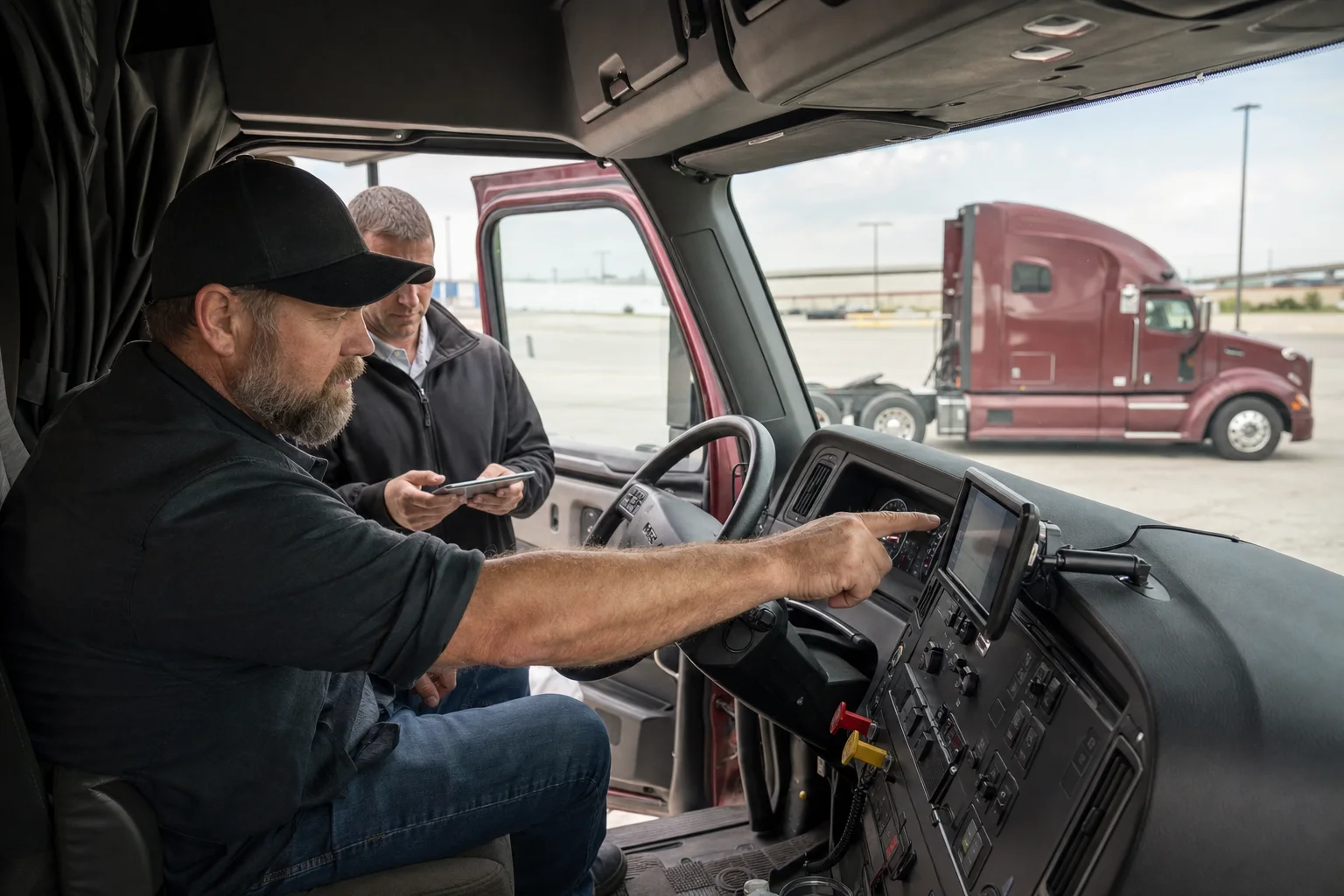
ELD compliance is not just installing a device. A carrier has to use the right logging method for each driver, apply the correct hours-of-service rules, review edits and unidentified driving, reconcile logs with the operation, and have a workable procedure for malfunctions and revoked devices. ELD and hours-of-service compliance services can cover one part of that job or provide recurring safety oversight.
What ELD and HOS compliance services include
Providers vary. Some primarily install and support ELDs. Others audit logs, train drivers and dispatchers, or provide broader outsourced safety support. The right scope depends on where the carrier’s actual problem is.
- Logging method review: determine which drivers must use an ELD, which qualify for a paper-RODS exception, and which qualify for a short-haul exception and use time records instead.
- ELD selection and setup: verify the device is on FMCSA’s registered list, establish driver accounts and permissions, connect the device correctly, and check roadside data-transfer functions.
- HOS rule review: apply the correct property or passenger rules, cycle, sleeper-berth provisions and exceptions to the routes and schedules the carrier actually runs.
- Recurring log audits: review HOS exceptions, edits, unidentified driving and supporting documents against dispatch and other business records.
- Malfunction response: establish the paper-log procedure, notification process, repair deadline and extension process required by 49 CFR 395.34.
- Driver and dispatch training: cover certification, personal conveyance, yard moves, sleeper-berth use, edits and what drivers need to produce during a roadside inspection.
- Corrective action: identify whether repeated violations come from drivers, dispatch practices, device configuration, recordkeeping or a combination of those factors.
- Post-inspection support: review an HOS violation or citation for factual or documentation errors and, where appropriate, help prepare a DataQs challenge.
What roadside inspectors actually find
In DCC’s three-year analysis, records-related Part 395 violations were substantially more common than violations for exceeding a driving limit. An ELD can record driving time correctly while the carrier still has a compliance problem involving certification, unidentified driving, false records, form and manner requirements or supporting documentation.
- No record of duty status, 395.8(a): DCC counted 73,505 citations in the analysis, including 68,851 marked out of service. Section 395.13 provides OOS procedures for a driver who does not have a current record of duty status and the required prior records.
- False reports, 395.8(e): these can be exposed when the RODS do not agree with fuel purchases, tolls, dispatch records, GPS data, shipping records or other information showing where the vehicle actually was.
- ELD record review and certification, 395.30: DCC counted 153,969 citations in the analyzed inspection data. Drivers must review and certify their records, and carrier-proposed edits must be confirmed or rejected by the driver.
- ELD form and manner, 395.24, and in-vehicle requirements, 395.22: roadside problems can include a portable ELD that is not properly mounted, missing required instruction material, or missing blank graph-grids.
These figures are DCC’s analysis of FMCSA inspection files, not an FMCSA published summary. The underlying inspection data can change as records are updated. The analysis window used here ends October 2, 2026.
Who must use an ELD and who can use an exception
Most drivers who are required to keep records of duty status under Part 395 must use an ELD that is on FMCSA’s registered list. Principal ELD exceptions include drivers who are required to use RODS on no more than 8 days in any 30-day period, qualifying drive-away-tow-away operations, and qualifying pre-2000 vehicles or engines. See FMCSA’s ELD site for current registration and guidance information.
- 8 days in 30 days: the rule uses any rolling 30-day period, not a calendar month. A driver who is required to use RODS on more than 8 days in that period generally becomes subject to the ELD rule unless another exception applies.
- Drive-away-tow-away: the exception is limited to qualifying operations where the vehicle being driven is part of the shipment, or where a qualifying motor home or recreational vehicle trailer is being delivered.
- Pre-2000 vehicles and engines: FMCSA guidance effective October 2, 2026 says that if the vehicle model year is pre-2000 based on the VIN, an ELD is not required. FMCSA also recognizes vehicles with engines predating model year 2000, including qualifying engine-swap or glider-kit situations, even when the vehicle VIN indicates a later model year. Motor carriers should maintain documentation of motor and engine changes at the principal place of business. See the current FMCSA pre-2000 guidance.
- Short haul: a driver who meets the applicable short-haul requirements under 49 CFR 395.1(e) does not prepare RODS and therefore does not need an ELD for that qualifying work. The carrier instead keeps the required time records.
- Short-term rental: FMCSA’s exemption for property-carrying CMVs rented for 8 days or less is currently effective through October 12, 2027, subject to its terms and documentation requirements.
An exception from the ELD requirement does not eliminate any HOS or recordkeeping requirements that otherwise apply. Local work is not automatically exempt. A provider should test the actual reporting location, radius, duty period and schedule against the applicable rule rather than relying on a label such as local or intrastate.
Hours-of-service limits at a glance
These are the principal federal limits in Part 395 for interstate property and passenger operations. Exceptions can change the result, so the table is a starting point for compliance review, not a substitute for applying the full regulation.
| Rule | Property-carrying CMV | Passenger-carrying CMV |
|---|---|---|
| Required off-duty period | 10 consecutive hours before the next driving period | 8 consecutive hours before the next driving period |
| Driving limit | 11 hours after 10 consecutive hours off duty | 10 hours after 8 consecutive hours off duty |
| Duty window | No driving after the 14th consecutive hour after coming on duty | No driving after 15 hours on duty following 8 consecutive hours off duty |
| 30-minute break | Required after 8 cumulative hours of driving without at least 30 consecutive minutes of interruption | No comparable federal 30-minute break requirement |
| Weekly cycle | 60 hours in 7 days or 70 hours in 8 days | 60 hours in 7 days or 70 hours in 8 days |
| 34-hour restart | 34 or more consecutive hours off duty can restart the 60 or 70-hour calculation | No comparable federal restart provision in 395.5 |
| Sleeper berth | Two qualifying periods totaling at least 10 hours, with one period of at least 7 hours in the sleeper berth and the other at least 2 hours off duty, in the sleeper berth, or a combination of the two | At least 8 hours in the sleeper berth, which may be split into two periods provided neither period is less than 2 hours |
| Adverse driving conditions | Up to 2 additional hours of driving time and an extension of the applicable driving window when the regulatory conditions are met | Up to 2 additional hours under the applicable passenger-carrier limits when the regulatory conditions are met |
| Short haul | 150 air-mile radius and release within the applicable 14-hour period, with required time records | 150 air-mile radius and release within the applicable 14-hour period, with required time records |
| 16-hour exception | Certain property drivers may extend the 14-hour window to 16 hours once in 7 consecutive days, subject to the conditions in 395.1(o) | Not available under 395.1(o) |
| Intrastate | States can adopt certain less restrictive intrastate limits within the federal authority in 49 CFR 350.305. The federal ceiling allows up to 12 hours driving, no driving after 16 hours on duty, 70 hours in 7 days or 80 hours in 8 days, and a 150-air-mile radius for the short-haul exception. The actual state rule still controls. | |
The federal HOS rules also contain provisions for agricultural operations, Alaska, oilfield operations, emergency relief and other circumstances. A carrier should identify the exact exception before relying on it. FMCSA’s Interstate Truck Driver’s Guide to Hours of Service is useful background for property carriers, but the CFR controls.
Which type of ELD and HOS help fits your operation
The carrier remains responsible for compliance when an outside provider performs reviews or monitoring. What matters is whether the provider will identify the problem, document the findings and clearly assign follow-up actions.
| Option | Usually suits | What the provider or vendor may handle | What the carrier still handles |
|---|---|---|---|
| ELD only, self-managed | Small fleets with simple operations and internal HOS knowledge | Device, software, technical support and vendor alerts | Log review, unidentified driving, supporting documents, driver coaching, corrective action and malfunction response |
| ELD plus in-house safety staff | Fleets with enough volume for an internal safety role | Daily or scheduled HOS oversight by an employee | Staffing, training, backup coverage and management of corrective action |
| Outsourced HOS log auditing | Carriers that have logs but lack consistent review | Scheduled log audits, exception reports, supporting-document comparisons and coaching findings | Implement corrective action and fix operational causes |
| Outsourced safety department | Carriers without internal safety staff or with broader compliance needs | HOS oversight plus other safety functions within the agreed scope | Provide records, make operating decisions and carry out required corrective action |
For broader outsourced safety work, see outsourced safety director and fleet safety management services.
What a useful HOS log audit should actually check
A useful audit does more than count ELD alerts. The reviewer should determine whether the recorded duty status is consistent with the carrier’s actual operation.
- Review the log: check driving time, duty-window violations, cycle violations, breaks, sleeper-berth use and unusual edits.
- Review unidentified driving: determine who was driving, assign legitimate unidentified time when appropriate, and document why time remains unidentified.
- Reconcile the operation: compare selected logs with dispatch records, fuel transactions, tolls, bills of lading, payroll or settlement records and other available business records.
- Check supporting documents: look for missing records and time or location conflicts rather than treating every ELD alert as a confirmed violation.
- Document corrective action: identify whether the cause was driver behavior, dispatch planning, training, a device problem or another process failure, then record what was done about it.
Audit frequency should match the carrier’s risk and history. A carrier with repeated HOS violations, large amounts of unidentified driving or an upcoming investigation generally needs more than an occasional spot check. Scope, sampling method and reporting should be agreed with the provider before recurring work begins.
Edits, unidentified driving and supporting documents
Under 49 CFR 395.30, drivers review and certify their records. A motor carrier may request an edit after the driver’s record has been submitted. The driver must confirm or reject the proposed change and recertify the record. The ELD retains the original record and the edit history.
Unidentified driving must be reviewed by the carrier. The time can be assigned to the appropriate driver when supported by the facts and accepted by that driver, or the carrier must annotate why it remains unassigned under 395.32. An ELD setting cannot make an otherwise inaccurate record compliant.
Supporting documents under 49 CFR 395.11 include bills of lading, itineraries or schedules, dispatch or trip records, qualifying expense receipts, fleet-management communications, and payroll or settlement records. Drivers must submit required RODS and supporting documents to the carrier no later than 13 days after receiving them. The carrier must retain up to 8 supporting documents for each 24-hour period that a driver is on duty. If more than 8 are available, the retained set must include the documents with the earliest and latest time indications plus 6 others. RODS and supporting documents must be retained for 6 months.
Malfunctions, the in-cab packet and revoked ELDs
When an ELD malfunctions, 49 CFR 395.34 sets the response:
- The driver notes the malfunction and notifies the carrier in writing within 24 hours.
- If the malfunction prevents accurate recording of HOS data, the driver reconstructs the RODS for the current 24-hour period and the previous 7 consecutive days unless those records are already in the driver’s possession or can be retrieved from the ELD.
- The driver uses paper RODS or another compliant method permitted by the rule while the malfunction prevents compliant electronic recording.
- The carrier repairs, services or replaces the ELD within 8 days of discovery or driver notification, whichever occurs first.
- If an extension is needed, the carrier must notify the FMCSA Division Administrator for the state of its principal place of business within 5 days after the driver notifies the carrier of the malfunction and submit the required extension request.
The required in-vehicle ELD materials no longer include the operator’s manual. FMCSA’s final rule effective July 22, 2026 removed that requirement. The remaining requirements include instructions describing ELD data-transfer mechanisms, instructions describing ELD malfunction reporting and recordkeeping procedures, and enough blank driver’s RODS graph-grids to record at least 8 days. Carriers can still carry the manual as a training or reference resource.
As of October 4, 2026, FMCSA’s current notices include five ELDs removed from the registered list on August 6, 2026. FMCSA instructs carriers using those devices to replace them with registered ELDs before October 6, 2026 and to use paper logs or logging software as directed during the replacement period. FMCSA states that continued use of the revoked devices on or after October 6 can result in a 395.8(a)(1) violation and the driver being placed out of service under the CVSA Out-of-Service Criteria. Because revoked-device notices change, carriers should check the current FMCSA notice rather than relying on an old list or a vendor statement.
Recent 2026 points that affect ELD compliance
- ELD operator’s manual: the requirement to carry a copy in the CMV ended July 22, 2026.
- Pre-2000 guidance: FMCSA issued revised guidance effective October 2, 2026 covering VIN model year, pre-2000 engines, glider kits and engine changes. It replaced the earlier guidance identified by FMCSA as rescinded on October 2, 2026.
- Paper-RODS exemption request: FMCSA denied the Federation of Professional Truckers’ request on September 30, 2026 for an exemption that would have allowed certain drivers to choose paper RODS instead of using an ELD.
- ELD revisions: FMCSA’s 2022 ELD Revisions document is an advance notice of proposed rulemaking, not a final rule. It raised possible changes involving pre-2000 engines, malfunctions, ELD removals, technical specifications and certification.
- HOS pilot programs: FMCSA has been developing Flexible Sleeper Berth and Split Duty Period pilot programs. Participation in a pilot does not make the proposed alternative schedules available to carriers generally.
Questions to ask an ELD or HOS compliance provider
- Which drivers and vehicles will you review, how often, and which data sources will you compare?
- Do you distinguish a system alert from a confirmed HOS violation?
- How do you handle unidentified driving and carrier-proposed edits?
- How do you document driver coaching and corrective action?
- Will you review supporting documents against the logs, or only review the ELD report?
- Are you independent of the ELD vendor, or do you resell or configure a particular system?
- What records and reports will the carrier receive at the end of each audit period?
No provider can guarantee zero violations. As of October 4, 2026, Appendix B to Part 386 provides a maximum civil penalty of $1,584 for each day that certain FMCSR recordkeeping violations continue, up to $15,846. Knowing falsification and other HOS violations can carry different penalties depending on the conduct and applicable provision.
DCC connects motor carriers and CDL drivers with independent ELD and HOS compliance providers. DCC does not perform the compliance work itself and is not affiliated with FMCSA.
Official sources: current 49 CFR Part 395, the ELD rules in Subpart B, FMCSA’s ELD site, and FMCSA’s current HOS guidance. Last reviewed October 4, 2026.
Get help with ELD and hours-of-service compliance
Tell us your fleet size, how your drivers log today and what is going wrong, whether that is roadside HOS violations, unidentified driving, an upcoming audit or a revoked device. We pass it to independent providers who handle this work.
Request HOS compliance help