
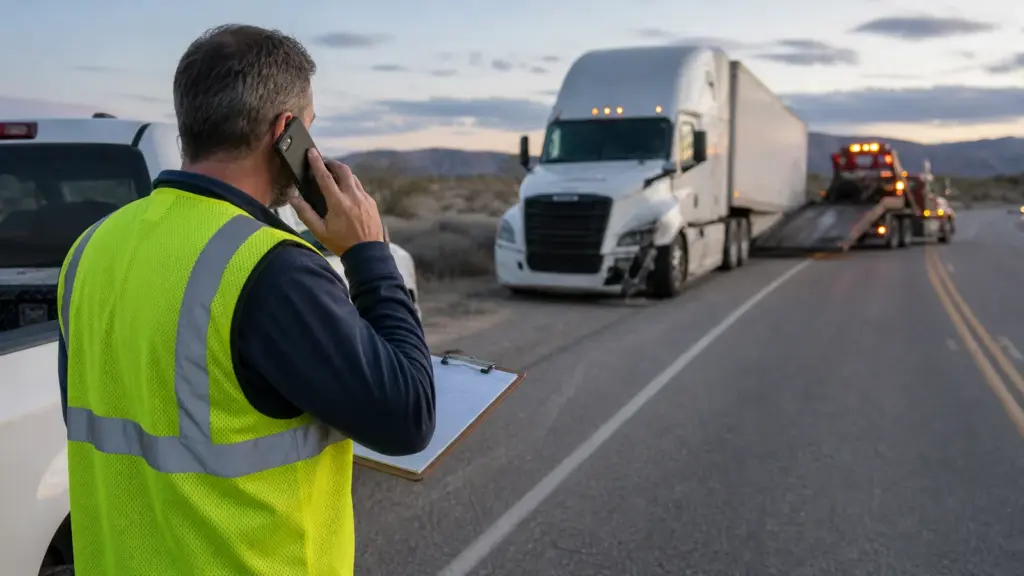
Post-accident testing is one of the easiest DOT rules to get wrong under pressure. A serious crash does not automatically require an FMCSA test, and a minor-looking crash can become testable when the citation and injury or tow criteria line up. A post-accident testing service gives the carrier a documented decision process, an after-hours collection path and a result workflow that works when dispatch, the driver and the safety team are dealing with an incident at the same time.
When FMCSA post-accident testing is required
The federal rule applies to CDL drivers operating commercial motor vehicles that require a CDL. The carrier must first classify the event using the federal accident definition, then apply the fatality, citation, injury and disabling-damage criteria. Company-policy testing, state workers’ compensation testing and law-enforcement testing are separate decisions and must not be recorded as DOT tests unless the federal criteria are met.
| Crash outcome | Citation condition | FMCSA test decision |
|---|---|---|
| A human fatality | No citation is needed | Test each surviving covered CMV driver involved |
| Immediate medical treatment away from the scene | CMV driver receives a qualifying moving-violation citation within 8 hours for alcohol or 32 hours for drugs | Test when both conditions are met |
| Disabling damage requiring tow-away | CMV driver receives a qualifying moving-violation citation within 8 hours for alcohol or 32 hours for drugs | Test when both conditions are met |
| No fatality, qualifying injury or disabling damage | Any citation status | No federal DOT post-accident test under Section 382.303 |
A provider should help the carrier work through this table without inventing facts. A tow for convenience is not necessarily disabling damage. Treatment at the scene is not the same as treatment away from the scene. The carrier should preserve police details, the citation status, the vehicle disposition and the time each fact became known.
The alcohol and drug testing clocks are different
The carrier should attempt alcohol testing as soon as practicable. If it has not occurred within two hours, the carrier must prepare and maintain a record explaining the delay. Attempts end after eight hours. The drug-testing window ends after 32 hours. A service provider can keep the dispatch log and locate an open site, but the carrier remains responsible for making timely attempts and documenting why a required test did not occur.
A driver required to take the post-accident alcohol test must not use alcohol for eight hours after the accident or until the test occurs, whichever comes first. The driver also must remain readily available for required testing. The employer should provide these instructions before drivers operate, not improvise them after a crash.
- Secure immediate safety and medical needs. Testing never comes before emergency response.
- Record the basic event facts. Capture time, location, vehicle, driver, fatalities, treatment, tow and citation information.
- Apply the federal decision criteria. Keep DOT and non-DOT company testing clearly separated.
- Contact the testing coordinator. Use a collection site able to conduct the correct regulated test and follow chain-of-custody procedures.
- Update the decision if a citation arrives later. The rule gives different citation windows for alcohol and controlled-substances testing.
- Close the two record paths. Keep controlled Part 40 and Part 382 testing records in the restricted testing file, then cross-reference the decision and any missed-attempt explanation from the carrier’s accident record without broadly exposing confidential results.
What a post-accident testing provider should handle
24-hour decision support
A real escalation number, not an inbox that is checked the next business day. The contact should understand FMCSA criteria and be able to document the decision.
Collection-site coordination
Confirm that the site is open, can perform the required DOT test and knows the driver is arriving. Rural and after-hours coverage should be discussed before a crash.
Correct test ordering
The order must identify the proper DOT agency, test reason and employer. A generic occupational-health screen is not a substitute.
Record package
Provide call logs, collection records, results and failed-attempt documentation in a format the carrier can retrieve during an audit.
Questions to ask before choosing a provider
- Is live help available every hour that our trucks operate?
- How do you verify an after-hours site’s actual availability before sending a driver?
- Will you walk our manager through the FMCSA decision criteria and document the answer?
- Can you distinguish a federal DOT test from a company-authority or state-law test?
- Who follows up on delayed citations and unresolved collections?
- What do we receive when testing is required but cannot be completed within the deadline?
- How are results and incident records delivered securely to our designated employer representative?
Common breakdowns that create audit exposure
Sending every driver for a DOT test is not conservative compliance. It can amount to using DOT forms and procedures when federal authority is absent. The opposite failure is waiting for a police report while the alcohol clock expires. Other recurring problems include using the wrong test reason, treating an ordinary hospital toxicology screen as the employer’s DOT test, failing to record two-hour alcohol delays, failing to keep the driver available for required testing or ignoring the post-accident alcohol restrictions. A pending post-accident result does not create a universal federal stand-down by itself; removal follows a positive, refusal or another applicable legal, qualification or employer-policy basis.
A credible provider will not promise that it can make every rural collection happen. It will show its escalation path, tell the carrier when a collection site is not truly available, and produce an evidence trail of reasonable attempts. The carrier should also train dispatch and managers to preserve facts without coaching the driver or making premature conclusions about fault.
Before drivers operate, the employer must provide the post-accident information, procedures and instructions they need to comply when a crash occurs. After-hours support can assist, but the carrier remains responsible for applying Section 382.303 to the known facts, ordering the correct tests and documenting required attempts. For drug testing, a qualified collector handles the specimen, an HHS-certified laboratory analyzes it, the MRO verifies the result and the DER receives and acts on that result. Alcohol testing uses qualified screening and confirmation personnel, including an STT or BAT as applicable, and does not use an MRO. A C/TPA performs only permitted coordination, and any later SAP evaluation or return-to-duty recommendation belongs to the qualified SAP.
What to have ready when requesting support
Provide the legal carrier name, USDOT number, DER contact, driver name and phone number, current location, DOT agency, event time, vehicle details and every known fact about fatalities, medical treatment, towing and citations. Do not include speculation. If the citation status is unknown, say so and arrange a specific follow-up time.
Use our DOT drug testing requirements checker for an initial FMCSA check. For the wider testing program, compare DOT drug and alcohol program management.
How DCC helps with this service
DOT Compliance Companies is a provider-matching marketplace. We help carriers and drivers compare listed providers and send a request to suitable businesses. The selected provider confirms its own scope, credentials, coverage and deliverables. Regulated decisions and the motor carrier's legal duties remain with the responsible parties described on this page.
Get help with a post-accident decision
Share the incident time, driver location and known fatality, treatment, tow and citation facts.
Request post-accident support